
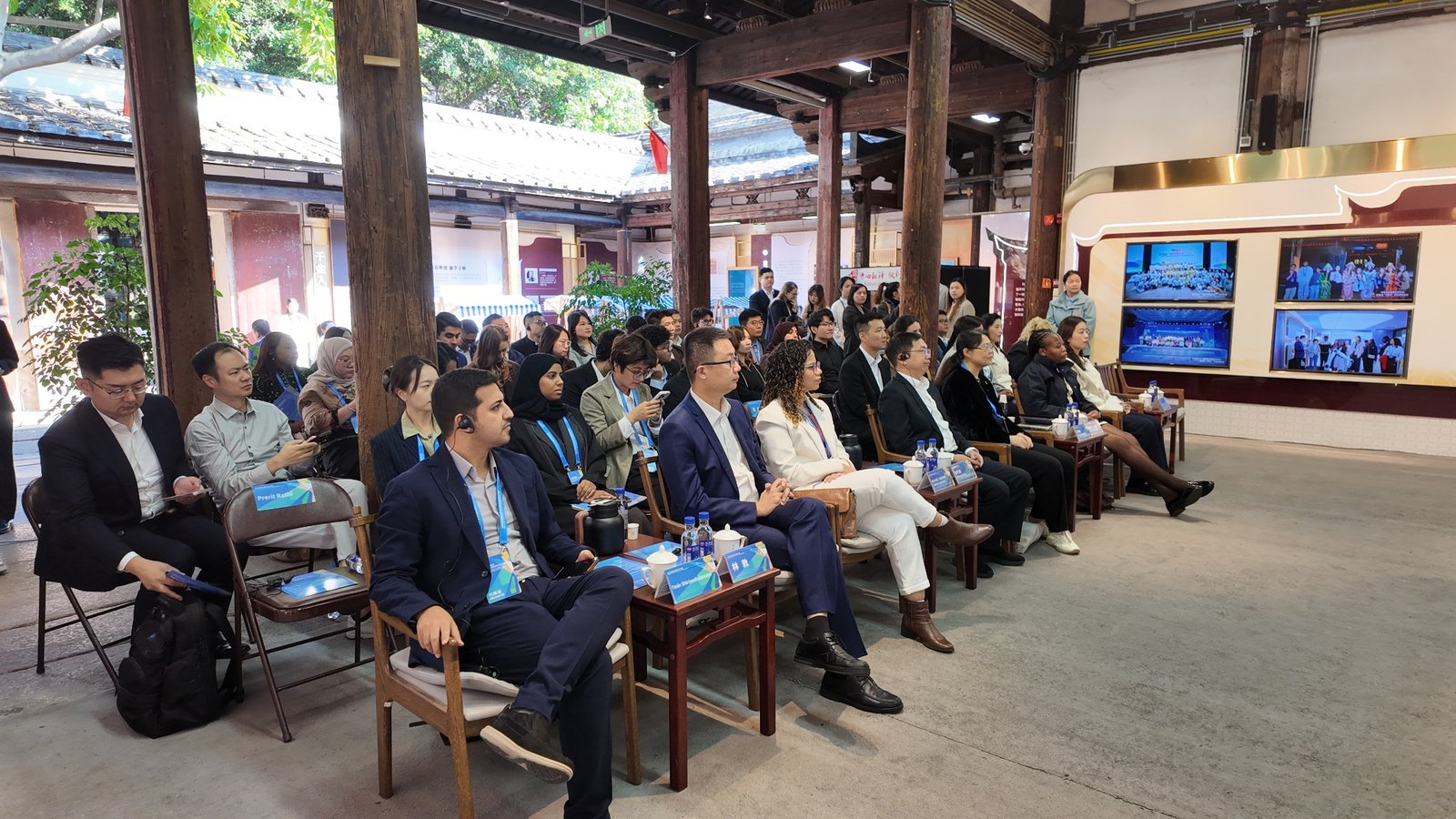
Young delegates from BRICS nations met on Tuesday in Fuzhou, in southeast China's Fujian Province, to talk about safeguarding cultural heritage, giving it fresh meaning and sharing it across borders. The gathering, called the International Youth Talk on the Global Civilization Initiative, took place at Zhuzifang Fund Harbor, an old riverside quarter where historic structures have been kept and reworked for contemporary purposes.
The China International Youth Exchange Center organized the event, and the Fuzhou Youth Federation played host. Its stated aim was to build cross-cultural understanding and get young people from various countries talking about how traditional culture can be protected and expressed in new ways, including through digital technology.
Zhang Afeng, vice president of the Fujian Youth Federation, drew attention to the Global Civilization Initiative (GCI) and what it means for exchanges among the young. China put the GCI forward in March 2023; it urges respect for the variety of civilizations, support for humanity's shared values, recognition of how civilizations are inherited and renewed, and closer people-to-people contact and cooperation between countries.
Zhang noted that Fujian has long-standing links with BRICS countries, and that cooperation reaches past trade into health, education, the marine economy and the digital economy. Trade between the province and BRICS nations made up close to one-fifth of Fujian's total foreign trade in 2025, he said. The Fujian Youth Federation, he added, will keep creating platforms where Chinese and foreign young people can meet, using technology as a bridge and civilization as a bond to deepen mutual understanding and work toward shared development.
Dong Lin, an associate professor at Fujian Polytechnic Normal University, walked the participants through Fujian's history and cultural traditions, folk songs and traditional woodcarving among them. The discussion that followed centered on two questions: how the young can carry traditional culture forward and fold it into present-day life, and how digital tools can open new avenues for cultural expression.
Attendees offered examples: digital supply chains used to bring traditional tea culture to today's consumers, and digital avatars plus artificial intelligence deployed to make traditional lacquerware easier to reach and more interactive. Others raised the promise of generative AI and augmented reality in lowering the barriers to cultural participation, letting people of different backgrounds join in cultural creation. The talks made clear that young people can be more than custodians of tradition; they can also push its renewal, using technology, creative methods and collaboration across cultures to give heritage new forms and keep it meaningful for current audiences.
The exchange spilled outside the meeting room. A day earlier, the delegates toured the Yantai Hill Historic and Cultural District, noted for mixing Chinese and Western architecture, and heard about work to preserve and renew its old buildings, carry architectural heritage forward and weave cultural tourism into urban development.
Marwan Elsafty, COO at Grecem, an Egyptian tech company, told CGTN that cultural exchange helps people from different countries locate common ground even when their thinking diverges. "We have some differences, so we need to find the middle ground. How we can find the middle ground? Just by cultural exchange," he said.
Anastasia Semenova, CEO of Russian video technology firm ViSaver LLC, said exchanges matter because people who stay in their own country may not grasp how others see the same events, opportunities or technologies. "When we all the time live in one country, in our own country, although it's our motherland and beloved, still we don't know how exactly the same things, the same events, the same opportunities, technologies, they are perceived in other countries, how people in other countries think about the same things," she said.
Siska Pebiana, a researcher at Indonesia's National Research and Innovation Agency (BRIN), said exposure to other cultures widens young people's horizons and helps them form friendships across borders, adding that open-mindedness and an understanding of different cultural backgrounds make connecting with foreigners easier. From historic neighborhoods to talk of technology and cultural innovation, the exchanges echoed the GCI's stress on dialogue and mutual learning among civilizations and underlined the part young people can play in keeping heritage alive and finding fresh ways to share it beyond borders.